

Bangladesh: After the Uprising, the Air Still Feels Thin
For readers outside Bangladesh, the fall of an autocrat might sound like an ending—the final scene, the credits rolling. Inside the country, it has felt more like the first morning after: disorienting, unfinished, and full of new shadows. The test now is not only who governs, but whether public life can stay open when intimidation is no longer centralized—when it disperses into mobs, threats, and the quiet, constant expectation of consequences.
Bangladesh is living through a transition in which the boundaries of speech are being redrawn in real time. What used to be enforced by the state is increasingly enforced socially—through pressure, violence, and the fear of being singled out, surrounded, made an example of. What follows is a reflection on how censorship survives these handovers, and what it does to a generation raised to be careful—learning silence, and trying, unevenly, to unlearn it.
*
After the fire
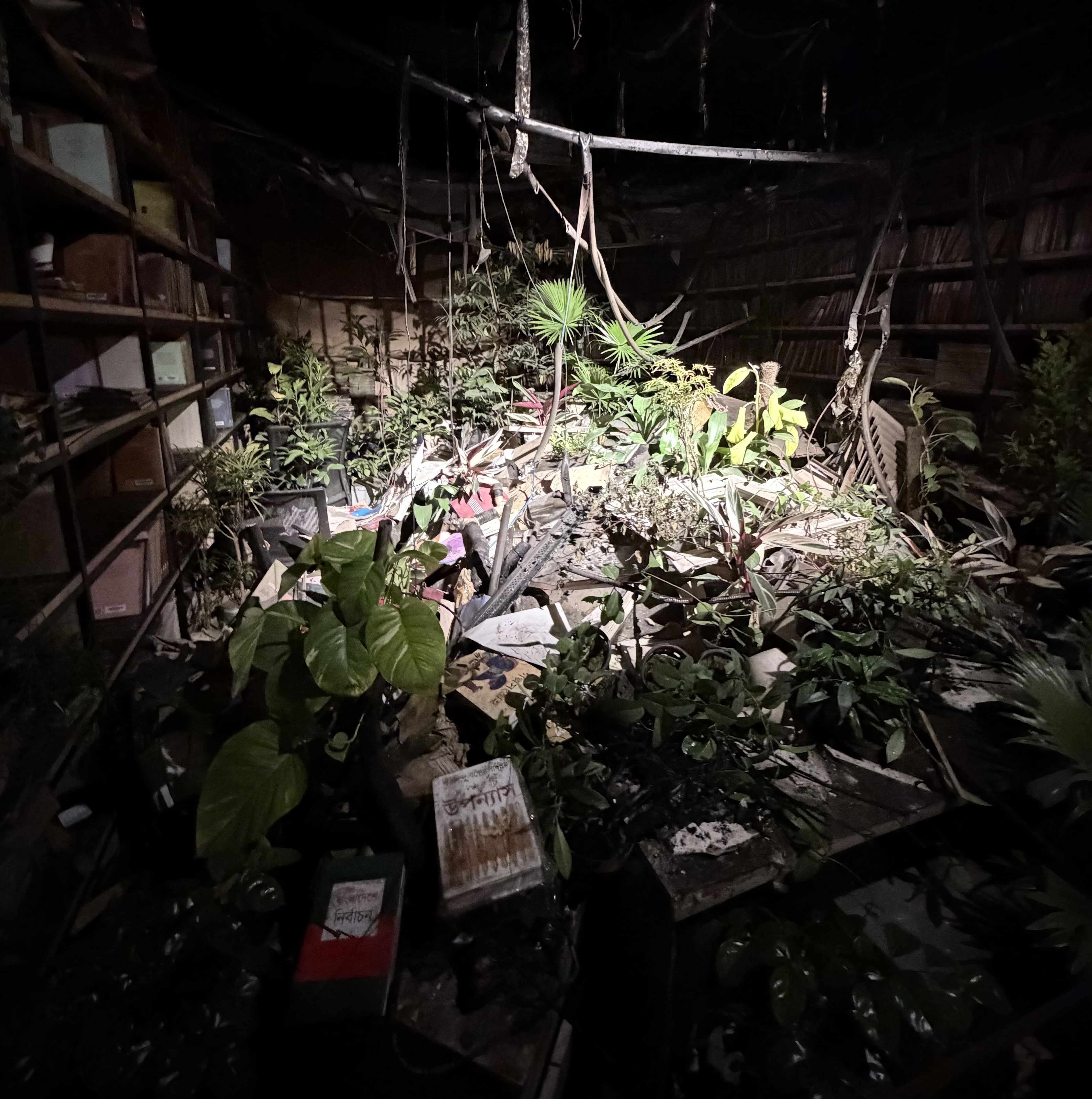
The strongest thing I remember from visiting the Prothom Alo office — the place where I held my first newsroom job as a journalist more than a decade ago — after it was burned by far-right mobs in December 2025, is the smell.
Not in the abstract way we talk about smoke in news copy— “arson,” “fire,” “torched”—but the intimate way it works its way into you. It clings to your clothes. It sits behind your tongue. It turns a familiar corridor into a place you don’t quite recognize. When coordinated mobs attacked and set fire to the offices of The Daily Star and Prothom Alo on December 18, 2025, and struck Chhayanaut, a cultural centre in Dhaka, the country didn’t just witness vandalism. It inhaled a message.
I keep thinking about paper—charred archives, soot-softened notebooks, the warped spines of books that were never meant to be evidence. In a place like Bangladesh, where so much history is carried in fragile forms—documents, songs, the memories of people who have learned to speak carefully—fire feels less like destruction than an attempt at erasure. It is the most literal censorship: if you burn the record, you get to rewrite what happened.
And yet the deeper wound, the one you can’t photograph, is what comes after: the hesitation to write anything down at all.
Groomed Into Fear
Since my teens, I was knowingly or unknowingly groomed into fear.
That sentence still surprises me when I say it aloud, because it sounds too deliberate—as if there was a classroom for dread, a curriculum, a graduation ceremony. But fear is rarely taught as fear. It is taught as common sense. You absorb it through pauses in adult conversations, through the lowered voice when a name is mentioned, through the casual warning that certain topics are “complicated”—and “complicated,” in our politics, is usually code for dangerous.
I came of age under a regime that didn’t need to shout its power all the time because it could make you whisper.
I came of age under a regime that didn’t need to shout its power all the time because it could make you whisper. You learned which jokes were safe in public and which belonged only in a trusted room. You learned how a phone call—from a security official, or someone speaking on their behalf—could upend your day. You learned that the law was elastic—able to stretch around anyone who drew too much attention, anyone who insisted on asking the “wrong” questions at the wrong time. You learned to watch the watchers.
It was slow-motion autocracy. Often bureaucratic. Consistent enough that fear began to feel like weather.
When the Air Changed
And then—briefly, shockingly—the air changed.
In July and early August 2024, a student-led mass uprising tore through that long, suffocating pattern. It began with the kind of energy that makes a country feel young again: students, ordinary families, people who had spent years enduring, suddenly standing upright. The movement evolved into a non-cooperation campaign and the protest shifted from the street to everyday life: strikes and shutdowns, boycotts, and a broad refusal to keep feeding the machinery of the state. In early August, Sheikh Hasina resigned and fled. It was the moment Nobel laureate Muhammad Yunus was named chief adviser of an interim government. For a moment, Bangladesh lived inside something rare: the ecstatic belief that the future was open.
To describe that period to someone far away—to a reader in Sweden, say, where democracy can feel like infrastructure —requires translation, because the fall of a dictator is not the end of the story. It is the start of the harder chapter: what happens to a society that has been bent for so long it forgets what it feels like to stand straight.
Autocracy doesn’t only live in a leader. It embeds itself in institutions, yes, but also in reflexes. When the state has punished speech for years, people don’t suddenly become free the day a ruler leaves. They become disoriented. They look around for the new limits. They wait to see what replaces the old ones.
In medicine there is something called a phantom limb—the sensation that an amputated body part is still there, still aching. After a regime collapses, societies often experience a phantom violence: the sense that the old threat should be gone, and yet the body politic continues to feel it. Fear remains, not because people are irrational, but because fear has been rehearsed until it becomes muscle memory.
You can see it in the way journalists still check over their shoulders. In the way parents still warn their children to be careful—even when those children have already proven, at enormous cost, that they are willing to be brave.
Bloodshed for Breath
This is the heartbreak of the generation that fought for breath.
We imagined freedom as oxygen—something you either had or you didn’t. We imagined that if we pushed hard enough, the air would return and stay. But breath is fragile. It is always contingent: on whether the state protects you, yes, but also on whether your neighbours will let you speak without punishing you for it.
That is why December matters.
By late 2025, Bangladesh was already living in the tensions of transition: the interim era, the contested narratives of the uprising, the uneasy question of what kind of democracy might emerge. Then came the coordinated attacks—on newspapers that, whatever your politics, represent an idea of public argument, and on cultural institutions that represent an idea of Bangladesh that is plural, secular, intellectually restless. The UN Human Rights Office described them as “mob attacks” on leading media outlets and cultural centres, including The Daily Star, Prothom Alo, and Chhayanaut, and placed them in a broader climate of intimidation.
What They Were Trying to Burn
To a global audience, it’s worth pausing to explain what these places represent—because they aren’t just addresses on a map.
The Daily Star isn’t simply an office building. It’s one of the country’s public records: a place where the day’s arguments are written down, where corruption is named, and where officials—at least sometimes—are forced to answer uncomfortable questions.
Prothom Alo is more than a newspaper, too. It reaches a huge audience and helps set the boundaries of public conversation. In Bangladesh, that kind of influence matters: it shapes what people feel allowed to say out loud, what becomes “normal” to debate at dinner tables, in classrooms, on buses.
And then there’s Chhayanaut, which can be hardest to translate if you didn’t grow up with it. Chhayanaut is a cultural home—built around music and memory. It carries Tagore’s songs and the traditions of Rabindra Sangeet, and a stubborn belief that Bengali identity is bigger than any single party, ideology, or religious claim. Every year it helps anchor Pahela Baishakh, the Bengali New Year—celebrated across Bangladesh in mid-April with public music, fairs, processions, and a kind of collective permission to be joyful in the open. In Dhaka, Chhayanaut’s New Year morning program at Ramna can feel like a national heartbeat: Bangladesh reminding itself, in public, that pluralism and joy belong here, too.
That’s why attacks on these institutions don’t feel like ordinary vandalism. They feel like an attempt to narrow the country—to shrink the space where people can speak, argue, and imagine themselves as one nation.
The New Censorship
When mobs attack these institutions, they are not only breaking glass. They are attempting to collapse the space in which a society can imagine itself as plural.
When mobs attack these institutions, they are not only breaking glass. They are attempting to collapse the space in which a society can imagine itself as plural.
This is the new censorship: not a law written with vague clauses, not a case filed in a distant court, but the threat of collective punishment—the sense that if you publish an investigation that punctures the approved narrative, or sing a song that defies the authorised idea of the nation, you may be targeted by people who do not need state permission to hurt you.
Under autocracy, silence is enforced from above.
In fragile transitions, silence can be enforced from anywhere.
This is how democracy dies twice: first by law, and then by the street.
Bangladesh knows the first death well. The Hasina era relied on legal and administrative tools—security laws, digital regulations, a culture of prosecution that could turn speech into liability. Even when reforms were announced, the point was often to keep the architecture intact while repainting the façade. The habit of that architecture—the idea that the state can regulate truth—doesn’t vanish overnight.
But the second death is more insidious, because it is less accountable. When mobs intimidate, responsibility becomes fog. Politicians can shrug. Officials can claim helplessness. Everyone can treat it as “unfortunate,” a byproduct of passion, rather than what it is: a strategy.
A mob does not need to pass legislation. It only needs to convince people that speaking is not worth the cost.
Witnesses in Power
This is why the question of Bangladesh in the beginning of 2026 is not primarily a question of personalities.
Yes, there is a new government. Tarique Rahman and the Bangladesh Nationalist Party (BNP) took power after a sweeping election victory, with Rahman sworn in on February 17, 2026. Their return to the state comes with its own scars: years of raids and arrests, courtrooms and sentences, the long stretch of exile in which a political life was reduced to speeches transmitted from far away—proof, to BNP supporters, that the Hasina era did not simply govern, it punished.
But a movement that has lived as a victim can still inherit the tools of victim-making. And that is where the story gets dangerous. It’s easy to fixate on the faces at the podium. Harder—and more urgent—to name the continuity underneath: the way speech is still policed, how intimidation migrates, how the gatekeepers of “acceptable” talk can change clothes and still keep the same keys.
In that sense, the new government is not the subject of the story. It is the witness.
The institutional test is simple to state and hard to pass: will the state protect the space for dissent and art when the mob comes knocking?
Because this is what transitions expose: whether a government believes in rights as a principle, or merely as a weapon.
It is easy to defend free speech when it flatters you. It is harder when speech challenges you. Harder still when the threat does not come from your formal opponents but from forces that claim to speak for “morality,” “tradition,” “the people”—the kind of language that can make violence sound like virtue.
The Story Under Contest
In Bangladesh, the far-right does not fear policy papers. It fears the story we tell ourselves.
The uprising of 2024 was, among other things, a narrative revolution. It rejected the idea that Bangladesh had to live inside one party’s version of history. It demanded that citizenship be reclaimed from fear.
But narratives are not owned by those who begin them. They are contested by those who arrive later and insist on a different meaning.
A country can topple an autocrat and still be vulnerable to the politics of purity. It can break one gate and discover other gates behind it. It can remove the censor in uniform and face the censor in a crowd.
This is where Chhayanaut becomes more than a cultural centre. It becomes a line.
Art as the Last Refuge
When politics fails—when institutions wobble, when parties calculate, when the state hesitates—art is often the last thing that preserves an inclusive national identity. Not because artists are saints, but because art is stubbornly human. It refuses to reduce people to factions. It makes room for grief and ambiguity and shared memory. It reminds you that your enemy has a mother, that your neighbour has a song, that the nation is not a battlefield alone.
That is why extremists target musicians and writers. They understand art as civic glue. Dissolve it, and society becomes easier to split into binaries: believer versus traitor, pure versus corrupt, “us” versus “them.”
And once a society is reduced to a binary, censorship becomes almost natural. You don’t even need to threaten people; they censor themselves in order to belong.
That is the ultimate success of fear: it convinces you that silence is safety.
The Uncertain Morning
I think about the children and teenagers who grew up under the long Hasina years—the ones who learned, like I did, that certain questions had consequences. Then I think about the students who walked into the streets in 2024 anyway, who watched friends die, who turned grief into a demand for breath.
International reporting has described that uprising as “Gen Z-led,” an upheaval that forced Hasina out and brought Yunus into the interim leadership. But if you are that generation, you do not experience it as a label. You experience it as a wound.
You remember the sound of slogans echoing off concrete. You remember the way a city feels when the crowd is bigger than your fear. You remember the sudden sense that your voice is not just yours—it is part of something collective.
And then, months later, you watch mobs set fire to the places that safeguarded public memory and cultural imagination.
That is when the morning becomes uncertain—not because you don’t know who governs, but because you don’t know what kind of society you live in now: one where the state might no longer be the primary censor, but where censorship has been outsourced to intimidation.
In February 2026, Bangladesh is trying to build a democracy inside the ruins of fear. The weight of the past is not only in court cases or constitutional debates. It is in nerves. It is in the pause before someone shares an article. It is in the way an editor wonders whether an investigation is worth the risk. It is in the instinct to look away.
The Duty to Keep Breathing
The writer’s duty, at this moment, is not to cheer for a party or to romanticize a charter. It is to insist that the space for expression must be defended regardless of who holds the gavel.
Because the gavel changes hands.
Fear is more persistent.
I return, in my mind, to the smell of December—the smoke in the archives, the silence after a mob leaves a building hollowed out. I imagine someone sweeping glass off a floor, picking up a half-burned page, trying to decide what can be salvaged. I imagine a musician standing in a hall that should be full of song, and hearing instead the echo of footsteps.
And then I imagine the smallest act in the world: someone opening a notebook. Someone typing a sentence. Someone choosing, once again, to speak.
This is what “breath” looks like after a revolution. Not grand declarations, not victory speeches, but the daily refusal to surrender your voice to whoever is loudest. The story we tell ourselves about Bangladesh will be written by those who keep writing even when the air feels thin.
A democracy if you can keep it is not a slogan. It is a practice. And the practice begins, always, with a person deciding not to be silent—even when silence is being offered, once again, as the price of safety.